Freshwater Life

Freshwater Life
Freshwater Life

The animals and plants that live in freshwater are called aquatic life. The water that they live in is fresh, which means that it is less salty than the ocean.The terrestrial (land) environment that surrounds the freshwater environment has a large impact on the animals and plants that live there. Some factors that influence the freshwater environment include climate, soil composition, and the terrestrial animals and plants in the area.

Just as on land, aquatic plants require carbon dioxide, nutrients (substances such as phosphate and nitrogen needed for growth) and light for photosynthesis, the process where plants make their food from sunlight, water, and carbon dioxide. Aquatic animals need to breathe in oxygen and consume food.

The physical conditions surrounding the body of water or wetland (lands that are covered in water often enough so that it controls the development of the soil) control the availability of these resources.

For example, the concentrations of nutrients, oxygen, and carbon dioxide in the water depend on how much air gets into the water and on the chemical composition of the land nearby. The sediments (particles of sand, gravel, and silt) in the water influence how much light reaches the bottom of the lake or river.

Groundwater Formation


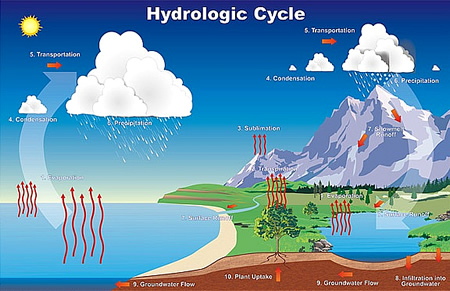
Groundwater is fresh water in the rock and soil layers beneath Earth’s land surface. Some of the precipitation (rain, snow, sleet, and hail) that falls on the land soaks into Earth’s surface and becomes groundwater. Water-bearing rock layers called aquifers are saturated (soaked) with groundwater that moves, often very slowly, through small openings and spaces.

This groundwater then returns to lakes, streams, and marshes (wet, low-lying land with grassy plants) on the land surface via springs and seeps (small springs or pools where groundwater slowly oozes to the surface).

Groundwater makes up more than one-fifth (22%) of Earth’s total fresh water supply, and it plays a number of critical hydrological (water-related), geological and biological roles on the continents. Soil and rock layers in groundwater recharge zones (an entry point where water enters an aquifer) reduce flooding by absorbing excess runoff after heavy rains and spring snowmelts.

Aquifers store water through dry seasons and dry weather, and groundwater flow carries water beneath arid (dry) deserts and semi-arid grasslands. Groundwater discharge replenishes streams, lakes, and wetlands on the land surface and is especially important in arid regions that receive limited rainfall.

Lakes

Lake
Lake

Lakes are large inland bodies of fresh or saline (salty) water. Lakes form in places where water collects in low areas or behind natural or man-made dams (barriers constructed to contain the flow of water).

Some lakes are fed by streams (natural bodies of flowing freshwater), and some form where groundwater (water flowing in rock layers beneath the land surface) discharges onto the land surface.

Water leaves lakes by flowing into outlet streams, infiltrating (soaking in) into groundwater reservoirs called aquifers, and by evaporating into the atmosphere (mass of air surrounding Earth). Lakes vary in size from large lakes such as the Great Lakes of North America, to small mountain lakes.

Lakes are larger than ponds, which are small bodies of fresh water that are shallow enough for rooted plants to grow. The study of ecology (relationships between living organisms and their environment) in lakes, inland seas, and wetlands is called limnology.

Ponds

Pond
Pond

A pond is a depression in the ground that is filled with water that remains year round. Ponds range in size from the artificial backyard projects about the size of a bathtub to bodies of water that are about the size of a football field. Ponds support a variety of animal and plant life, and are also used as recreational sites by people.

The difference between a pond and a lake involves size and water depth. A lake is big enough to have at least one beach (sand or rock that slopes down to the water) and contains enough water to generate waves from the wind that blows across the surface of the water.

In contrast, a pond is usually too small for waves of any size to form. At the center of a lake, the water can reach depths of many hundreds, even thousands of feet (meters). A pond, however, is a shallow and still body of water where sunlight can usually reach down to the bottom.

How ponds form

Natural ponds form in shallow depressions where rainwater (including runoff from nearby higher areas) collects. Water from an underground source such as an underground spring can also collect into a pond.

Rivers

River
River
Rivers are bodies of flowing surface water driven by gravity. Hydrologists, scientists who study the flow of water, refer to all bodies of flowing water as streams. In common language, it is accepted to refer to rivers as larger than streams. Water flowing in rivers is only a very small portion of Earth’s fresh water.

The oceans contain about 96% of the water on Earth, and most fresh water is bound up in glacial ice near the North and South Poles. Rivers shape the landscape and are integral to the hydrologic cycle (circulation of water on and around Earth) on the continents.

Rivers shape the lands as they erode (wear away) and deposit sediment (particles of gravel, sand, and silt) along their courses. Running river water acts to level the continents. When geologic forces slowly raise (uplift) mountain ranges, rivers wear them away.

The streams that form the Ganges River of India (headwater streams), for example, are presently tearing down the Himalayas almost as quickly as they are uplifted by the movements of Earth’s crustal plates (plate tectonics).

Stream Systems

Stream Systems
Stream Systems

Streams are any size body of moving surface fresh water driven towards sea level by gravity (force of attraction between two masses). Water scientists refer to all bodies of flowing surface water as streams regardless of size, yet in common language, streams are considered smaller than rivers.

Stream systems are networks that collect fresh water runoff from the land and carry it to the ocean. Together, tree-shaped systems of small branch streams drain vast areas of the continents into large rivers.

Stream systems of all sizes erode (wear down) sediment (particles of gravel, sand, and silt) along their courses and carve complex patterns into the landscape. They wear down slowrising mountains and fill valleys and lowlands (low and level lands) with layers of sediment. Stream systems change character along their courses.

Steep mountain streams feed shallow elevated streams that in turn flow into meandering rivers that snake across broad floodplains (flat, low-lying land near a stream that is covered with water when the stream overflows its banks). Deposits of sediment form at river mouths, the area where fresh river water enters the ocean.

Stream Water Flow

Stream Water Flow
Stream Water Flow

Water flows downhill due to Earth’s gravity (force of attraction between two masses) pulling it. Streams, like rivers, are gravity-driven bodies of moving surface water that drain water from the continents.

Water scientists, called hydrologists, refer to all bodies of running water as streams, no matter their size so, in one sense, rivers are large, well-established streams). In everyday communication, it is common to refer to streams as smaller than rivers.

Streams transfer water that falls on the land as precipitation (rain, snow, sleet, and hail) to the oceans. Streams, again like rivers, constantly shift their courses and change length. The stream is carried along a defined path, called a channel. Water flowing in stream channels is a powerful sculptor that carves landscapes and molds sediment (particles of rock, sand, and silt).

It wears down mountain ranges and cuts deep canyons through solid rock. Stream waters support vibrant communities of plants and animals, and they have been the lifeblood of human civilization for thousands of years. Streams shape the land and are also integral to the hydrologic cycle (circulation of water on and around Earth).

Related Posts Plugin for WordPress, Blogger...